



In today’s modern enterprise where every question is a data question, the precision and reliability of data is non-negotiable. Inaccurate data leads to poor decision-making, decreased productivity, compliance risks, and more…
That’s where Data Reconciliation comes in.
As a critical process in Data Quality Management, reconciling data involves comparing data from disparate sources to ensure accuracy, consistency, and completeness, safeguarding against costly errors and skewed insights.
By comparing data at a row-by-row level, Data Reconciliation identifies inconsistencies between datasets.
How Is Data Reconciliation Used?
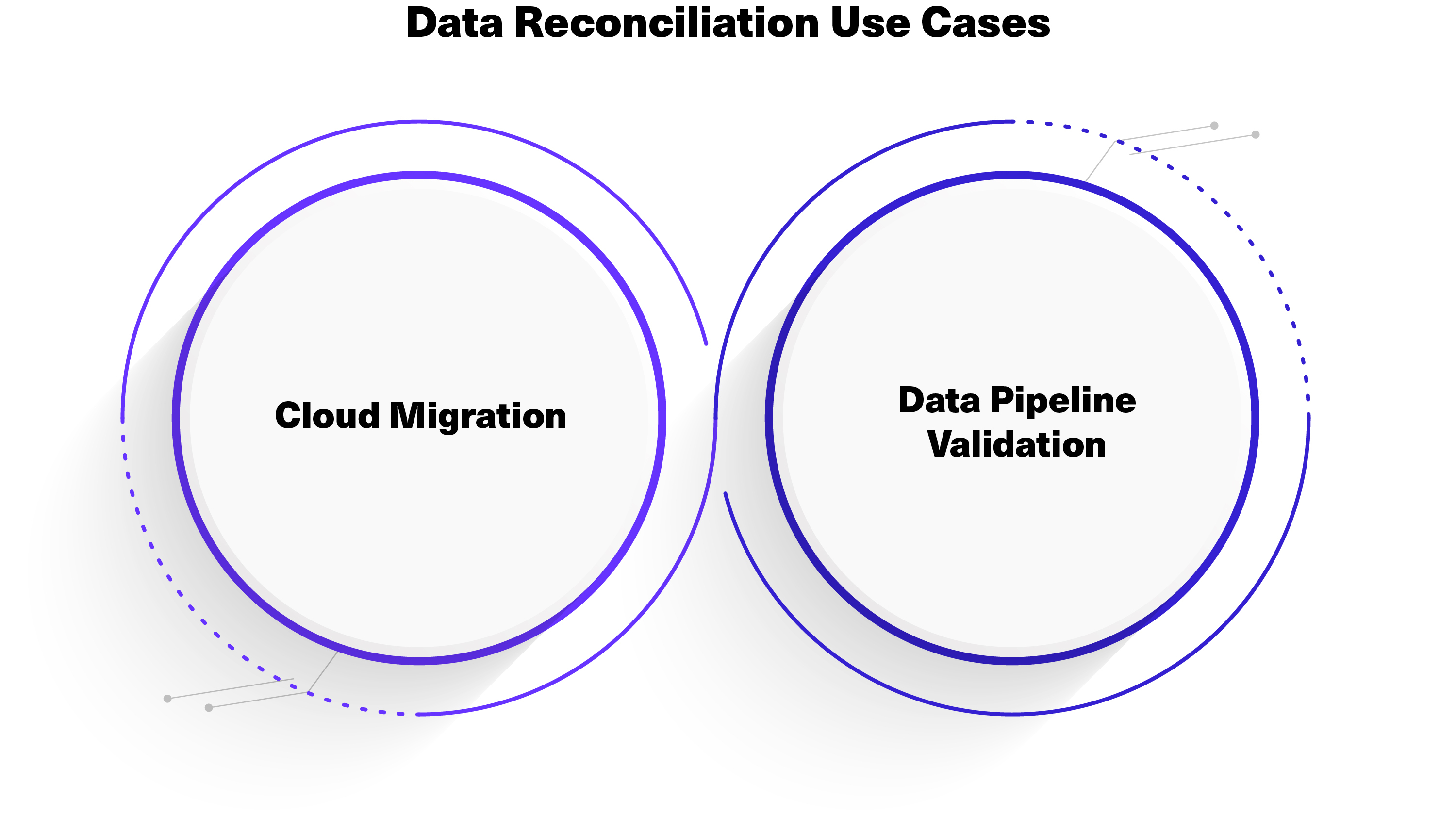
The two most common use cases for Data Reconciliation are Cloud migration and data pipeline validation.
Cloud Migration
As companies embark on Cloud migration journeys, uncertainties arise regarding unfamiliar data, its life cycle, and the entire data process. Lightup’s Data Reconciliation instills confidence by revealing disparities between on-premises and Cloud solutions, fostering user trust and facilitating a smooth migration.
Data Pipeline Validation
In the dynamic realm of data movement and transformation, every handover increases the potential for data mutation and deniability of issues. Lightup’s Data Reconciliation empowers engineering teams to showcase proper data migration, highlighting any disparities and ensuring a robust validation process.
How It Works
Lightup’s no-code/low-code Data Reconciliation Checks enable you to compare data row by row from different data sources.
Watch a short demo to see how it works in Lightup.
Comparing Key and Target Columns
Specify key and target columns to uniquely identify records and focus on relevant data points for comparison.

Extracting Relevant Data
Lightup extracts pertinent data, optimizing the reconciliation process by minimizing data volume.
Comparing Local Data
Sophisticated algorithms analyze data locally, identifying discrepancies without the need to transfer data between sources.

Discarding Raw Data
Prioritizing security and compliance, Lightup discards raw data post-comparison, mitigating potential risks.
Percentage Matching
Visualizations display the percentage of matching data, enabling quick identification and resolution of discrepancies.

Why Lightup?

Efficiency
Automate data comparison, saving time and resources, and streamline the reconciliation process.
Accuracy
Enhance data accuracy by comparing data row by row, across different data sources, increasing user adoption and confidence.
Data Security
Discard raw data post-comparison, protecting sensitive information from unauthorized access.
Ease-of-Use
Lightup’s user-friendly interface provides clear visualizations, making it easy for users to interpret results and take action.
Improved Decision-making
Reconciled data boosts reliability, leading to better decision-making and insights.
Customization
Tailor the reconciliation process to specific business needs, ensuring flexibility and adaptability.
Reconciling Data with Lightup
Data breaks all the time. Sometimes for no reason. And when data is in motion — moving from different source systems to various destinations — data is especially prone to errors. That’s why reconciling data is a critical process in maintaining high Data Quality.
With Lightup, enterprise teams can perform row-by-row comparisons across different data sources — without writing Python scripts or complex coding.
Ultimately, by leveraging Lightup, enterprise organizations can easily understand where data discrepancies exist and prevent them from percolating throughout enterprise data pipelines, mitigating the risks of downstream escalations.